Frequently Asked Questions About Landfill Emissions Studies
This is your Services Page. It's a great opportunity to provide information about the services you provide. Double click on the text box to start editing your content and make sure to add all the relevant details you want to share with site visitors.
1
What is a landfill emissions study?
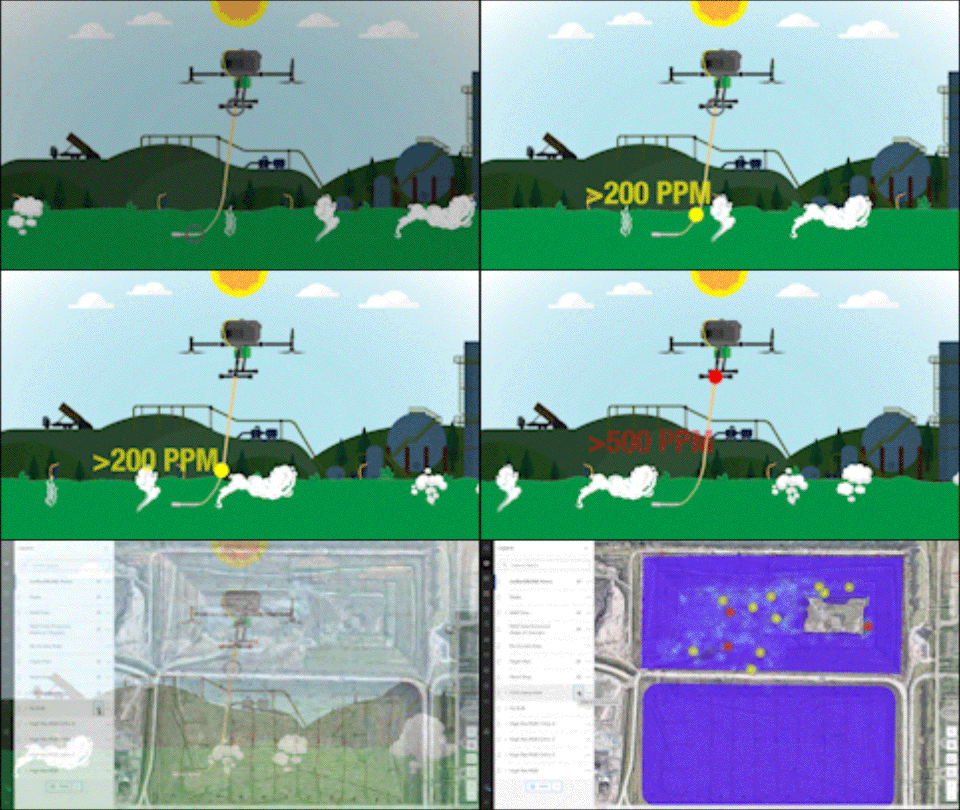
A landfill emissions study is a comprehensive assessment of methane emissions across a landfill. Using advanced methane detection technologies, emissions studies identify, map, and quantify methane emissions from the landfill surface, infrastructure, and operational areas. The resulting data helps operators understand emission patterns, improve landfill gas collection efficiency, reduce odors, and support strategic planning.
2
How is a landfill emissions study different from compliance monitoring?
Compliance monitoring is performed to satisfy regulatory requirements and identify surface emissions that exceed established thresholds (typically 500 ppm).
-
Method-specific calibration and procedures
-
30m Spacing or Jurisdiction
Specified Limit -
Pass /Fail Reporting and Remediating at 500ppm (or Jurisdiction Specified Limit)
-
Strict Regulatory Timeline for Repairs
-
Limited Value for Improved Gas Collection
Landfill emissions studies are voluntary evaluations designed to provide a deeper understanding of methane behavior across a site. Emissions studies typically focus on identifying methane hotspots, evaluating gas collection system performance, assessing fugitive emissions, and generating data that can support gas collection optimization, RNG development, and future compliance planning.
-
Tighter Spacing for Increase Data Collection
-
Emission Sources from 1 ppm to 100% Methane
-
No Hard Deadline for Repair
-
Data is Confidential (No Regulatory Hammer)
-
Additional Data Reporting Options
-
Interpolated Maps
-
Change Detection Maps
-
Emissions Quantification
-
Flux Plane Analysis
-
Wellfield Visualization
-
3
Why should a landfill conduct emissions studies if it is already performing compliance monitoring?
Compliance monitoring identifies areas that exceed regulatory limits. Emissions studies provide additional operational intelligence by revealing methane sources that may not trigger compliance thresholds but still represent lost gas, odor concerns, or collection system inefficiencies.
Many operators conduct emissions studies to proactively identify issues, optimize gas collection systems, reduce greenhouse gas emissions, and maximize methane recovery before regulatory monitoring occurs.
4
What information can a landfill emissions study provide?
A landfill emissions study may provide:
-
High-resolution methane maps
-
Identification of methane hotspots
-
Fugitive methane emissions locations
-
Methane quantification data
-
Flux plane analysis results
-
Total methane flow rate estimates
-
Odor source identification
-
Gas collection system performance insights
-
Data to support wellfield optimization
-
Information for RNG feasibility assessments
5
What is methane quantification?
Methane quantification is the process of measuring the amount of methane being emitted from a landfill or other facility. Unlike simple leak detection, quantification estimates methane emission rates and can be used to evaluate gas collection performance, calculate greenhouse gas emissions, support environmental reporting, and forecast gas recovery potential.
6
What is flux plane analysis?
Flux plane analysis is a methane quantification technique used to estimate total methane emissions from a landfill or facility. By measuring methane concentrations and wind conditions across a defined plane downwind of the site, operators can estimate the total methane flow rate and better understand site-wide emissions.
Flux plane analysis can help support gas collection optimization, methane recovery forecasting, and system design decisions.
7
Can emissions studies help improve landfill gas collection systems?
Yes. Emissions studies often identify areas where methane is escaping before it reaches the gas collection system. This information can be used to improve wellfield design, adjust extraction rates, evaluate cover performance, prioritize repairs, and increase overall gas collection efficiency.
8
Can emissions studies help increase RNG production?
In many cases, yes. Methane that escapes from the landfill surface cannot be recovered and converted into renewable natural gas. By identifying methane loss areas and optimizing gas collection performance, operators may improve methane capture rates and increase the amount of gas available for RNG projects.
9
How often should landfill emissions studies be performed?
The appropriate frequency depends on site objectives, operational changes, and regulatory considerations. Operators perform emissions studies monthly, quarterly, semi-annually, or annually to evaluate gas collection performance, monitor changes over time, and support planning activities.
Additional studies may be conducted following major construction activities, expansion projects, gas collection upgrades, or RNG development initiatives.
10
Can emissions studies identify odor sources?
Yes. Methane emissions studies help identify areas where landfill gas is escaping and contributing to odor complaints. By locating emission sources, operators can target corrective actions that reduce odors and improve community relations.
11
Are landfill emissions studies only for regulatory compliance?
No. While emissions studies can help operators prepare for future compliance activities, they are often used for operational improvement, gas collection optimization, odor management, greenhouse gas reduction initiatives, RNG development, and infrastructure planning.
12
How accurate is drone-based methane detection?
Drone-based methane detection systems provide high-resolution methane measurements across large areas quickly and safely. Advanced systems such as SnifferDRONE™ allow operators to survey difficult terrain, steep slopes, active disposal areas, and geomembrane-covered surfaces while collecting detailed methane concentration data.
In this independent study, the SnifferDRONE method was determined to have this highest accuracy for leak localization and the second-highest accuracy for quantification among landfill methane detection technologies and methods.
13
Can emissions studies support gas collection system design?
Yes. Methane quantification and emissions mapping data can provide valuable information for wellfield planning, gas collection expansion projects, landfill cell development, and renewable natural gas infrastructure design.
Understanding where methane is being generated and where it is escaping helps engineers make more informed system design decisions.
14
What are the benefits of conducting emissions studies before compliance monitoring?
Many landfill operators conduct emissions studies in advance of regulatory monitoring to gain additional time and flexibility for identifying, prioritizing, and addressing methane emission sources.
Voluntary studies can be performed at tighter survey spacing than compliance requirements, providing greater visibility into site conditions and helping operators make repairs before formal monitoring occurs. This proactive approach often improves operational efficiency, supports better planning, and reduces the likelihood of unexpected compliance findings.
15
Who can benefit from landfill emissions studies?
Landfill emissions studies provide value for:
-
Landfill owners and operators
-
Environmental managers
-
Landfill gas collection system managers
-
RNG developers
-
Consulting engineers
-
Environmental consultants
-
Sustainability teams
-
Municipal solid waste organizations
Any organization seeking to improve methane recovery, reduce emissions, optimize gas collection performance, or support renewable natural gas development can benefit from landfill emissions studies.